

The Evolution of Work and What It Means Today (and for tomorrow)


Work has changed more in the last 80 years than in the previous 800. And the pace isn't slowing down, it's accelerating.
At 4xi, we spend a lot of time thinking about the future of human experience: in the workplace, in education, in healthcare, in senior living, and beyond. Our latest article, The Evolution of Work, explores a simple but powerful idea:
The lessons we've learned from designing great consumer experiences are the same lessons that will shape the future of every human-centered institution.
Let's take the journey. A Timeline Worth Studying
In 1946, ENIAC was the world's first general-purpose computer. It weighed 30 tons and was operated by specialists in secret military labs. Work meant controlled access, specialized knowledge, and institutional gatekeeping.
By 1964, the IBM 360 brought computing to the office. Work became institutionalized, hierarchical, and defined by physical presence. The corner office became a symbol of status and progress.
Then came 1985 and the personal computer. The cubicle era. Work was controlled and professional, but technology was still intimidating, manuals were required and help desks were overwhelmed.
In 2007, the iPhone changed everything. Open offices replaced cubicles. The consumer experience invaded enterprise. Work started feeling like life, and life started feeling like work.
And now, in 2026, we're in the AI-Native era - flexible, belonging-centered, intelligent. The office has become a destination, not a default. Work is an experience, not a location.
The question on the table: What comes next?
Work Is Now an Intelligent Consumer Experience
This is more than a philosophical observation. It's a practical reality that leaders across every sector need to grapple with.
The best consumer products share a common DNA, they're:
Easy to use (intuitive from day one, no manual required)
Failure friendly (safe to experiment and iterate)
Meaningful and social (creating connection and shared purpose)
Visually appealing (beautiful design signals quality and respect)
Real time (instant feedback, personalized and contextual), and
Accessible (available anywhere, anytime, on any device).
Great workplaces need to share that same DNA.

Think about it this way: IKEA figured out that great design removes the need for explanation. Every employee touchpoint: onboarding, performance feedback, space navigation, IT support should feel just as intuitive.
Complexity is the enemy. Organizations that still rely on 40-page employee handbooks and IT ticket queues are delivering a 1985 experience in a 2026 world.
The Numbers Don't Lie
The connection between employee experience and business outcomes is no longer a soft argument.
73% of customers say employee experience drives brand loyalty
4X is the factor that EX focused companies attract and retain customers
+21% Engaged employees drive higher profitability
The experience of customers is the company. And the company is its employees. These aren't separate strategies, they're the same strategy.
Intrinsic Rewards: What Actually Makes People Stay
Beyond compensation and perks, what keeps people engaged, at work, in learning, in care, in community, comes down to six intrinsic motivators:
The Value of Association: how people feel being connected to your brand
Forever Curious & Learning: how you educate and advance knowledge
The Feeling of Belonging: how you welcome, retain, and sustain community
Sense of Progress: how you maintain momentum on the journey
Image & Pride: how you nurture and stimulate pride in the work
People & Culture: how you put people first in all that you do
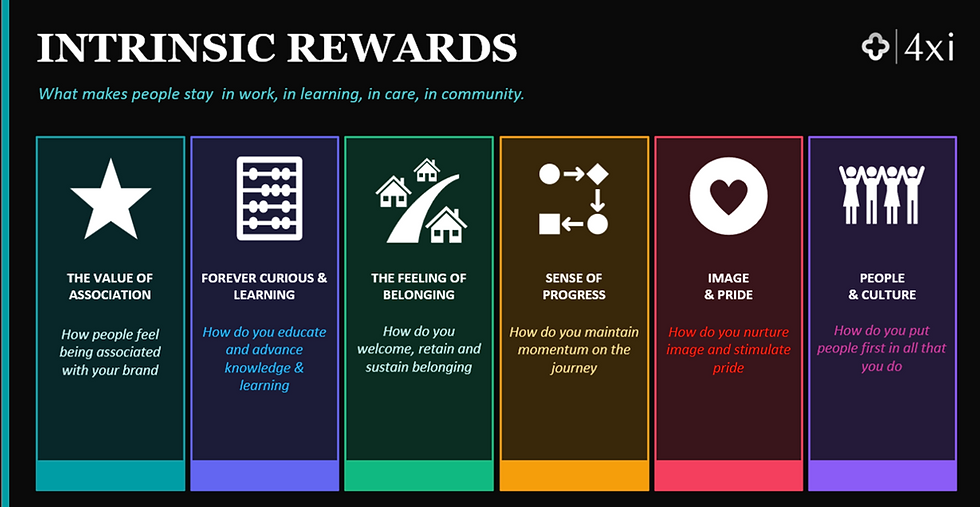
These are the things that consumer products do brilliantly, and that workplaces too often overlook.

Work has evolved so quickly over the last 70 years. How we work today is unimaginable to our parents. They don’t get why we get paid to do what we do. We are not making anything with our hands, but we don’t wear a tie. CEOs don’t even have offices.
The Parallel Revolution
Here's the bigger idea, and the one we're most excited about at 4xi.
The forces reshaping the workplace are the same forces reshaping every human-centered industry.
Every sector (including Education. Healthcare. Senior Living. Higher Education. Retail. Financial Services.) that touches human lives is moving through the same arc, from:
Centralized to dispersed: services unbundle from central locations
Provider-controlled to consumer-empowered: choice replaces compliance
Institutional to consumerized: institutional XP adopt B2C design standards
Restricted to accessible: technology removes barriers of geography and income
Rigid to flexible: outcomes replace time-based structures
Fragmented to seamless: friction disappears
Generic to AI-powered: intelligent systems personalize at scale
In education, the classroom is giving way to personalized AI tutors, micro-credentials, and lifelong learning. In healthcare, the hospital is coming to the patient, remote monitoring, home diagnostics, ambient care. In senior living, the model is shifting from institutional care to dignity-first, connected communities. In retail, physical stores are becoming brand experiences, not transaction points.
The organizations that understand this parallel revolution, and act on it, will lead their industries. Those that don't will be disrupted.
What Comes Next: The 2040 Horizon
Our best projection for 2040+ is an Ambient era: adaptive, powered by Agentic AI and Extended Reality (XR), with work happening everywhere and access becoming essentially invisible.
AI agents handling 60%+ of knowledge work autonomously
XR environments blending the physical and digital seamlessly
Workplaces designed for creativity and human connection, not computation
Outcome contracts replacing time-based employment
Every human-centered industry redesigned around the individual
The office of 2040 will feel as unfamiliar to us today as the cubicle farm feels to Gen Z.
The Design Challenge, and the Opportunity
At 4xi, we believe the biggest design challenge of this era is building the enterprise capability to match the consumer experience expectation.
That means creating systems, processes, people, and culture for continued design, development, and support. It means starting with the human experience: employee, customer, student, patient, resident and working backwards. It means treating the workplace not as a cost center or a compliance requirement, but as an experience platform.
The best consumer brands aren't just product companies. They're experience companies. It's time for every enterprise to become one too.
Three Questions to Ask Yourself Today
Does your employee experience match your customer experience ambition? If your onboarding takes 3 weeks and your app sign-up takes 3 minutes, you have a design problem, not a technology problem.
Are you building for 2026 or 2036? The signals of the ambient era are already visible. Are you reading them?
Where in your organization is complexity the enemy? Every unnecessary step, approval, form, or friction point is a tax on your people's experience, and ultimately on your performance.
The Evolution of Work is an ongoing conversation. We'd love to hear what signals you're already seeing.
Download the full study on the Evolution of Work below:
To explore how 4xi can help your organization design exceptional human experiences in the workplace and beyond Get in touch.
About 4xi Global Consulting: 4xi is a team of talented leaders from both the client-side and service provider side, impacting the Human Experience (HX) for people at work, in education, rest, and at leisure. We believe in a people-first, experience-led philosophy. Whether client, employee, or guest - their experience is the fundamental foundation of success.The Path to Long-Term, Sustainable Human Experience Success
Organizations that follow this methodology unlock the power of human experience as a competitive advantage. By establishing a clear vision, aligning with business objectives, and implementing structured design and governance, companies can create a consistent, engaging, and value-driven experience across their global portfolios.
This is not just about standardization - it’s about creating places where people choose to be, where employees thrive, customers engage, and partnerships flourish.
The road to human experience excellence is paved with intention, data-driven insights, and a commitment to continuous improvement.
Are you ready to take the next step?


4xi Global Consulting & Solutions is a team of talented leaders from both the client-side and service provider side, impacting the Human Experience (HX) for people at work, in education, rest, and at leisure.
We believe in a people-first, experience-led philosophy. Whether client, employee, or guest – their experience is the fundamental foundation of success.

We work with corporations, service providers, and innovators:
Strategic Advisory & Special Projects (SPx)
Headquarters Fractional Support On-Demand
Evolving Experiences© - Employee (EX) & Customer Experience (CX)
Design4Life©: Environmental, Physical, and Experiential Design
Global Amenities Strategy, Design & Operations
TRUE NORTH©: Strategic Partnership & Growth
Sustainability Simplified©: Supply Chain & Innovation
Market Research Reports & Benchmarking
Project Management Office
Food Craft Culinary Consulting
CREATE. : Graphic Design and Creative Services
DATAxi: Data Ingestion and Visualization
Explorers Innovation Directory: Gateway to Innovation

4xi is proud to be Chair of WORKTECH Academy for North America and a member of its Leadership Advisory Board. 4xi is a Global Ambassador for WORKTECH Academy.
San Francisco | New York | Philadelphia | Orlando | North Carolina | Seattle | Silicon Valley | Santiago | London | Tokyo


Comments