

AI in Hospitality: Balancing People and Technology

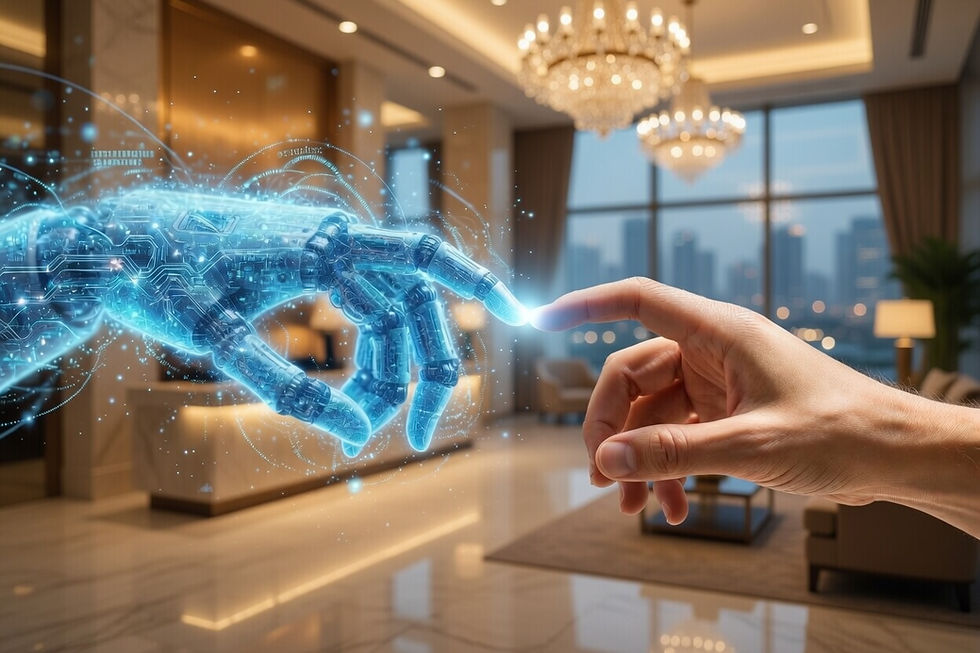
We are all obsessed with AI - and rightfully so. It feels like if you don't lean into it, it will run you over. Customers expect organizations to use every arrow in their quiver to create meaningful, frictionless, timely experiences.
But that cuts both ways.
Imagine a guest checks into a hotel after a long travel day. The app checked them in automatically, the room was ready early because AI predicted their arrival window, and their preferred floor was pre-selected based on past stays. It allowed them to use a digital key to check in, and they walked past the front desk right to their room. As they neared their room, they received a welcome text message from the front desk.
Pretty impressive stuff so far.
But when they arrived in their room, they found it wasn't cleaned properly, there was only decaf coffee, and the TV remote batteries were dead. They replied to the welcome text message to complain and were connected to a bot.
The bot apologized. Offered points. Closed the ticket.
The guest left a two-star review. Because what they needed in that moment wasn't a points top off. They needed a human being to look them in the eye (or at least sound like one on the phone) and say, "I'm so sorry. Let's fix this."
I have lived this in my many travels. And for me, the failure was two-fold. The great technology is a huge help when I arrive late and can head right to my room - but so often I find that there are issues with the room itself, which is a completely human error. Most often, it really is a remote control that doesn't work, or there is no regular coffee for the in-room machine.
That's the paradox we're living in right now. AI is doing incredible things for hospitality, food and beverage, travel, and every service-driven business you can name.
But the brands that consistently win are the ones who are melding technology and human connection - more like a cyborg than a robot. Robocop rather than Terminator, if you are a nerd like me.

Ready to up your hospitality or leadership game with our engaging, interactive sessions? Schedule your training session, workshop, or on-site assessment today.
Too many organizations are approaching AI as a technology play or cost-savings exercise, when it is clearly an experiential strategy. This is not a shiny object that can be layered onto broken customer journeys or under-trained teams and magically create customer loyalty.
That said, AI does have the potential to become a powerful tool to drive scale, understanding, and ease within the customer experience.
Where AI Is Winning
There is no doubt that AI belongs in your business - the operational gains are real and potentially very significant. AI-powered chat handling reservation questions and resetting passwords at 2 a.m. are the obvious tactical wins. Overall accuracy improves, response times drop, and these daily items don't inconvenience your customers.
But the deeper win is personalization at scale. Think about what the best server or front desk agent does naturally - they remember the returning guest's name, their dietary restrictions, and small details or preferences from their last visit. AI can now surface that information for every team member, every shift, every moment. This is the opposite of replacing the human touch, it gives your team the tools to deliver it more consistently.
And on the operational side, predictive staffing, inventory forecasting, and proactive service recovery alerts are changing how smart operators run their businesses. If your systems can flag a guest who had a delay, a complaint, or a subpar experience before they reach the checkout desk, you have a shot at turning that around.
Like with any new technology - from computers to self-checkout - it is an opportunity not to eliminate staff, but rather to repurpose to higher-value, higher-touch tasks that inspire customer loyalty.
Now those are powerful potential differentiators.

Where AI Falls Flat
Here's the truth nobody in the tech space wants to say: AI cannot feel, and it does not care. It can simulate empathy and be trained to say the right words, but when a guest is upset, anxious, overwhelmed, or just having a really bad day, they are craving a real, human connection that AI cannot replace.
Loyalty is like trust, hard to cultivate and easy to lose. AI can accelerate both of those paths depending on the circumstances.
For all the progress and advances AI is bringing, there are still clear areas where it has opportunities for improvement. The issue is often not the technology itself, but how it is being applied within organizations. When AI is layered on top of poor design, unintentional strategies, or lack of operational execution, it tends to amplify the problem instead of solving it.
One common failure is over-automation. Organizations become so focused on efficiency and cost savings that they remove the ability for customers or guests to reach a person when it matters. Guests get stuck in chatbot loops, phone trees, or app self-service and can't figure out how to bust out of The Matrix to find a human being.
AI may be great at gathering feedback and even surfacing issues where service recovery is needed, but it can come up short when it comes to resolving the issue. Systems designed to get customers to a person when needed will have the most success here, as often it takes a person-to-person connection for service recovery to be successful.
There is also a gap between insights and actions - as AI surfaces patterns and trends, organizations must translate that learning into behaviors and tactics to improve the experience. When leaders invest in advanced analytics but don't convert that to training or operational improvement, the overall experience will not improve.
Another potential issue is the complexity that AI can add to frontline teams. In theory, AI should simplify the work, but in practice, this often leaves employees navigating new systems without training, balancing multiple systems during the transition, and all the anxiety that change brings all on its own. It's crucial that implementation of these tools are as intentional as the actions they should be driving.
The takeaway is that AI struggles when it replaces human connection, adds complexity, or doesn't fuel executional adaptations or change.

How to Implement AI in Your Business (While Keeping a Human in the Loop)
This is where it gets practical, because the "how" is where most businesses get stuck.
Start with friction and remove it deliberately
Before you invest in any system, take a hard look at where your experience is breaking down or where there is a need to focus. Where are customers waiting, repeating themselves, or following up unnecessarily? Where are employees spending time on tasks that do not add value to the guest?
Automate confirmations, reminders, and follow-ups so customers are never left guessing
Use voice and chat AI to handle routine questions and basic support
Streamline booking, waitlists, and reservation changes
Identify and fix common friction points before they become complaints
Build real customer understanding and personalization at scale
Hospitality has always been about knowing your guests, but most organizations are still relying on information that is guesswork, scattered, or inconsistent. AI gives you the ability to change that, but only if you treat it as a strategic priority. This is where AI becomes a true differentiator.
Create 360° guest profiles that combine POS data, reservations, feedback, and digital behavior into one usable view
AI-driven segmentation that identifies VIPs, frequent guests, high-value customers, and at-risk segments automatically
Real-time visibility into preferences, order history, spend patterns, and visit frequency
Triggers that prompt personalized actions before, during, and after the visit
When this is done right, personalization stops being a marketing tactic and becomes an operational capability. Your team walks into every interaction with context, which allows them to recognize, anticipate, and respond in a way that feels intentional instead of generic.
73% of customers expect better personalization as technology improves - Salesforce
Use AI to prepare and empower the frontline
AI should enable and empower your team, not replace them. This is where many organizations miss - they invest in systems but do not translate that into something usable for the team delivering the experience.
Provide pre-shift insights that highlight key guests, special occasions, preferences, and potential service risks
Surface guest profiles in real time so employees do not have to ask repetitive questions
Offer guidance such as next-best actions that support decision-making without scripting behavior
Train teams on how to use insights naturally in conversation
When employees are informed and confident, they can focus on connection instead of information gathering.
Keep a human in the loop, while automating routine processes
Not every part of the journey needs to be automated, and leaders need to be clear about where the line is. AI should handle predictable, repeatable tasks, while people should own the moments that require empathy, judgment, and presence.
Automate routine inquiries, transactions, and basic service interactions
Use AI to flag frequent, recurring issues, trends, and opportunities
Ensure people step in for service recovery, complaints, celebrations, and high-value interactions - and ensure those triggers work every time
Empower employees to make decisions in those moments without unnecessary escalation
If you automate everything, you lose what makes hospitality work.
Improve the employee experience along the way
AI is not just a customer experience tool. It is an employee experience tool, and if you ignore that, you will limit its impact. When your team feels comfortable with new technology and innovations, they will both use and embrace them in their daily work.
When employees have better tools, better information, and less noise, they deliver better service.
Reduced administrative workload and eliminate duplicate systems
AI for forecasting and staffing so teams are not stretched thin
Prioritized insights so teams know what actually matters during a shift
AI becomes a support tool that helps employees succeed, not something that monitors them

Let's finish by talking about the elephant in the room - your team is watching what you do with AI very carefully and some of them are very concerned. Anxiety in the face of such fast-moving change is understandable and this creates an opportunity for great leadership.
Teams need to see AI as their new coworker and embrace the scale and pace that it brings to improving the guest experience.
Be transparent about what AI will and won't replace in your business. Communicate early and often - and celebrate where the irreplaceable human connection lives and how it will be better enabled through this new tools. In a world full of automated touchpoints, the team member who turns an angry guest into a raving fan deserves to be recognized.
The housekeeper who noticed a guest left their medication behind and got it back to them.
The server who remembered a family was celebrating an anniversary and brought out a dessert without being asked.
The team member who notices a guest looks lost or confused and offers assistance.
Those moments matter more now, not less.
I asked AI "How do you think you can best support hospitality and customer experience professionals to take better care of their guests?"
To which it responded: "My role in hospitality is not to replace the human connection that defines great service, but to help teams show up better prepared for every guest interaction. I can bring together guest history, preferences, allergies, spending patterns, and past experiences instantly so employees begin the conversation informed instead of scrambling for information. What I cannot do is feel empathy or read the emotional tone of a moment, and that is exactly why hospitality professionals remain at the center of the experience."

Customer Experience and hospitality are constantly evolving - and will continue to evolve. Organizations that find ways to embrace innovation and technology such as AI will find themselves positioned not only to provide better customer experiences, but to compete in the marketplace. The reality is that not only will customers expect these enhancements to service, but also the efficiencies in time and price that they will bring.
When you align CX strategy and frontline hospitality in this way, the results are clear. Customers experience less friction and more relevance because the system understands them. Employees feel more prepared and confident because they don't have to start from zero in every interaction. This also allows leaders to better gather and implement customer feedback + insights to continue to drive ongoing improvements.
But most importantly, this technology can drive personalization at scale and keep people squarely at the center of everything you do.
Tony
(Crafted by a human, not AI.)
Meet Tony Johnson

Tony is the Co-Managing Partner, Co-Owner, and Chief Experience Officer (CXO) for 4xi Global Consulting. He is an internationally recognized thought leader and influencer in Customer and Employee Experience. Tony hosts the wildly successful Customer Service Academy podcast and is the author of two books on leadership and CX.
Tony has worked with some of the top organizations across the globe, including Delta, 3M, Baylor Scott and White Health, University of Virginia, Siemens, SHRM, and more.
Tony is available to help your organization with:
Employee training and development
Executive and leadership coaching
CX and EX strategy creation
Inspirational keynote talks
Fractional Chief Experience Officer

Evolving Experiences, a 4xi brand, focuses on Customer Experience (CX) and Employee Experience (EX) as growth engines. By creating fierce loyalty with both employees and customers, organizations can differentiate themselves in an ever-changing and competitive marketplace.

4xi Global Consulting & Solutions is a team of talented leaders from both the client-side and service provider side, impacting the Human Experience (HX) for people at work, in education, rest, and leisure.
We believe in a people-first, experience-led philosophy. Whether client, employee, or guest – their experience is the fundamental foundation of success. We work with corporations, service providers, and innovators:
Strategic Advisory & Special Projects (SPx)
Headquarters Fractional Support On-Demand
Evolving Experiences© - Employee (EX) & Customer Experience (CX)
Design4Life©: Environmental, Physical, and Experiential Design
Global Amenities Strategy, Design & Operations
TRUE NORTH©: Strategic Partnership & Growth
Explorers Innovation Directory: Gateway to Innovation
Sustainability Simplified©: Supply Chain & Innovation
Market Research Reports & Benchmarking
(C) 2026. May not be used to train A.I.


Great post! The debate on AI in hospitality is so timely. Balancing operational efficiency with that essential human warmth is definitely the biggest challenge hoteliers face today. It is clear that while AI can streamline backend processes and handle routine inquiries, it can never replace the genuine empathy and nuance of human staff.
Interestingly, this "balancing act" reminds me of how hardware developers must balance quality and cost-effectiveness. Just as hotels must choose the right tech partners, developers often rely on Chinese PCB manufacturers to ensure their smart devices are both reliable and scalable. Maintaining quality at every level is truly key!
Excellent article from Tony Johnson